The constitutional stakes hidden inside the 2026 defense bill.
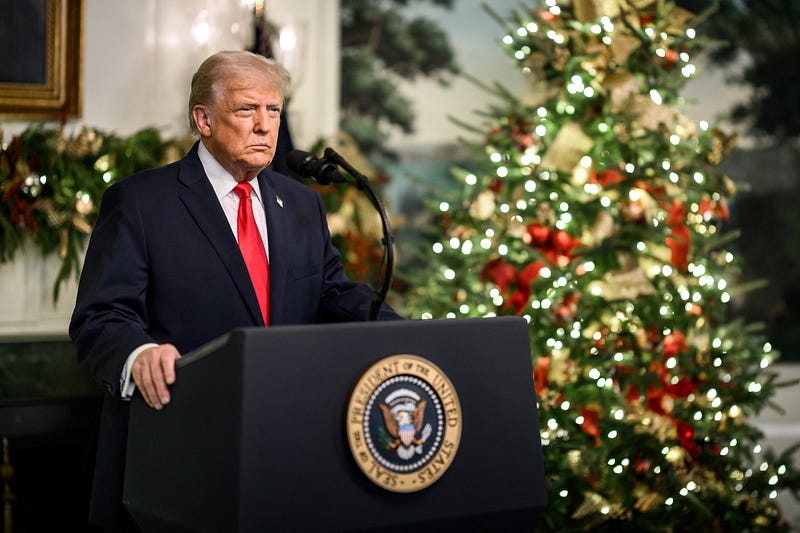
Last week, President Donald Trump signed the National Defense Authorization Act for Fiscal Year 2026 into law.
Such moments rarely linger in the news cycle. Coverage, where it existed at all, focused on topline defense spending, border security provisions, and a handful of done-to-death culture-war disputes.
Almost no attention was paid to the document Trump issued alongside the bill: a presidential signing statement that reads less like boilerplate and more like a constitutional warning label.
That neglect isn’t surprising. Signing statements don’t make good television. They aren’t press releases, and they don’t lend themselves to viral clips or partisan theatrics. But they are often where presidents are most candid about how they intend to govern. This one is no exception.
Trump’s statement does two things at once. On the surface, it endorses the NDAA’s core aims — funding the military, strengthening the defense industrial base, expanding missile defense, protecting U.S. airspace, countering drones, and securing the southern border. Beneath that endorsement, however, runs a far more consequential argument: a sustained rejection of Congress’s growing habit of micromanaging national security through statute.
The key phrase appears again and again: “My Administration will treat these provisions consistent with the President’s constitutional authority.” In Washington, this is not ornamental language. It is code. It means the executive branch reserves the right not to comply.
The objections themselves are familiar to anyone who has followed the long tug-of-war between Congress and the presidency.
Trump argues that Congress cannot dictate U.S. positions in foreign affairs, compel recognition of foreign governments, or condition troop deployments and withdrawals on advance certifications when doing so interferes with the President’s role as Commander in Chief. It cannot force disclosure of sensitive intelligence, deliberative materials, or details of compromised operations. It cannot order the President to recommend legislation, structure budget requests to advance congressional priorities, or grant security clearances by fiat.
None of this is new. What is striking is how rarely it is explained.
Signing statements are routinely framed as evidence of executive overreach when issued by Republican presidents, and waved away as legal housekeeping when issued by Democratic ones. That double standard has done real damage to public understanding of how the constitutional system actually works.
George W. Bush was savaged for issuing signing statements during the war on terror, accused of constructing an “imperial presidency.” Barack Obama, by contrast, issued signing statements raising many of the same objections — on detainee transfers, intelligence reporting, and war powers — often using nearly identical language. The difference was not substance.
It was coverage.
Trump’s NDAA statement fits squarely within this bipartisan tradition. What distinguishes it is not extremism, but bluntness. Rather than treating congressional encroachments as symbolic or harmless, Trump names them and rejects them outright. He does so in writing, on the public record, signaling to courts, agencies, and future administrations how he understands the presidency.
This matters because Congress has increasingly attempted to govern national security by accumulation — layering reporting requirements, funding conditions, and procedural tripwires onto must-pass legislation until the President’s ability to act quickly is constrained. That approach may feel reassuring in an era of polarized politics. It is also constitutionally dubious.
The framers did not design a system in which 535 legislators collectively conduct war or diplomacy. They vested those responsibilities in a single executive precisely because unity, speed, and discretion sometimes matter. Courts have long recognized this reality, especially in matters of foreign affairs and military command.
None of this requires admiring Trump, trusting Trump, or voting for Trump. It requires only a basic understanding of how the separation of powers actually functions.
That understanding is in short supply. Most coverage of the NDAA treated the bill as an ideological battleground, ignoring the institutional struggle underneath it. The signing statement lays that struggle bare: Congress asserting itself as a co-executive, and a President pushing back.
Whether one applauds or fears that pushback depends. But the stakes go beyond personality. They concern whether the presidency remains an office capable of action — or slowly becomes a clerkship constrained by legislative fine print.
Signing statements are not a loophole. They are a signal. And this one makes clear how Trump intends to govern: forcefully, constitutionally, and with considerably less patience for congressional micromanagement than many of his predecessors.
That may make for dull cable television. Fortunately, this is not cable television: It’s civics.
But please, more about Trump’s tweets.
(Contributing writer, Brooke Bell)